





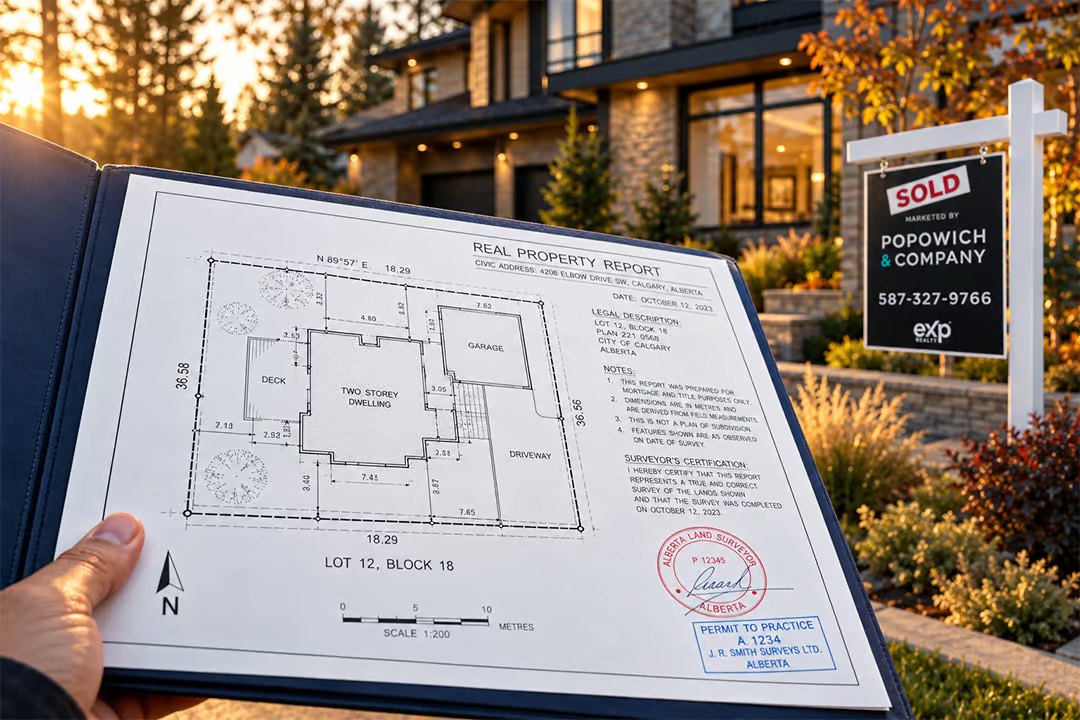
A Real Property Report (RPR) is a legal document prepared by a licensed Alberta Land Surveyor that shows the boundaries of your property and the location of every permanent structure on it. If you are selling a home in Calgary, your purchase contract will require you to provide one.
Key takeaways
- Most Calgary sellers are required by both the listing agreement and the purchase contract to provide a current RPR with a municipal stamp of compliance (Certificate of Compliance).
- Order it before you accept an offer, not after: surveys usually take 2 to 3 weeks and can take 4 to 6 weeks or longer.
- If your RPR reveals an encroachment or a non-compliant structure, it does not necessarily stop your sale; the right disclosures and agreements can keep a deal on track.
- You may be able to reuse an existing RPR if nothing on your property has changed since it was prepared; if anything has been added or altered, get it updated.
What Is a Real Property Report in Calgary?
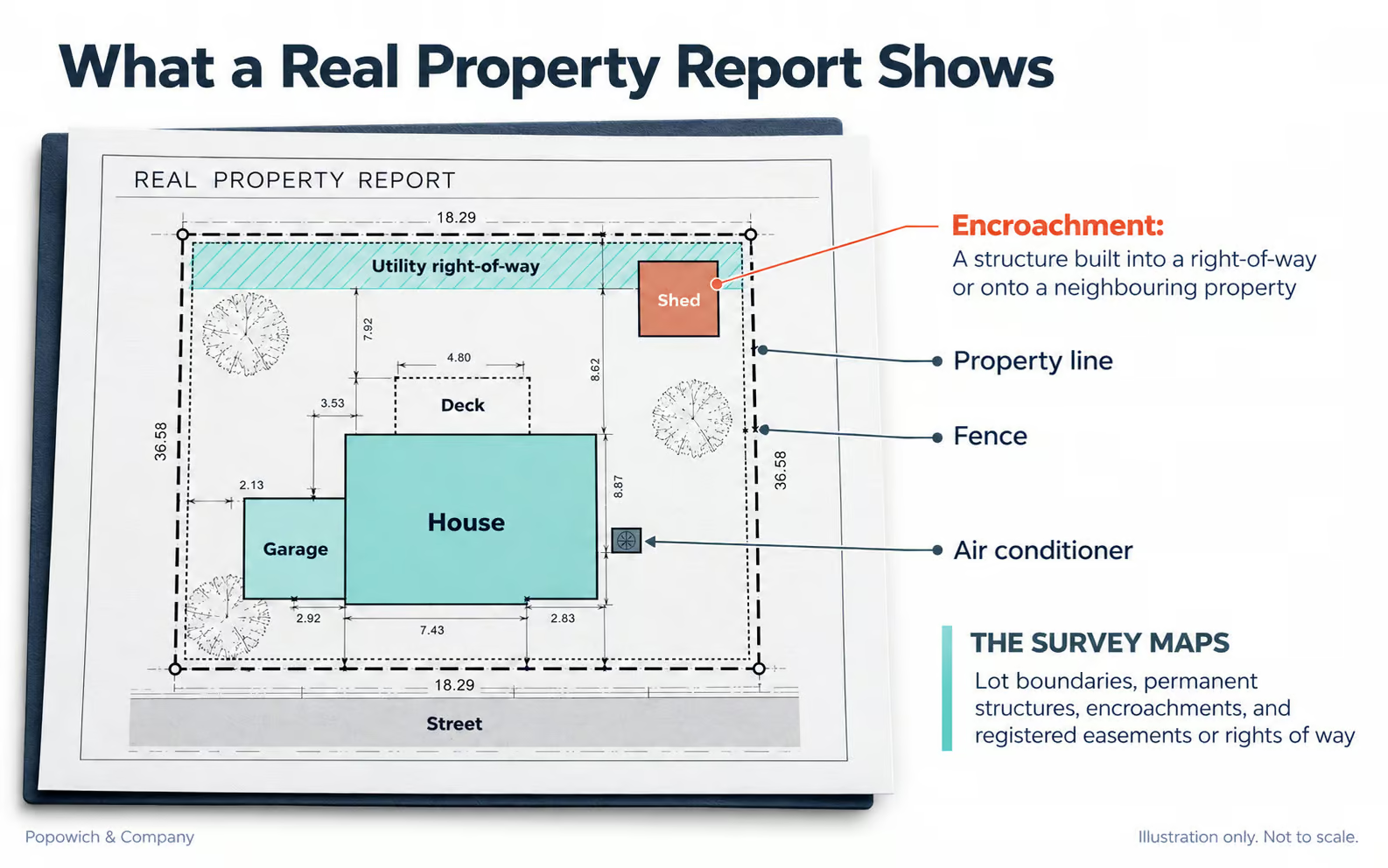
A Real Property Report is a surveyed drawing of your lot. It shows the legal boundaries of the property, the location of your house, garage, deck, fences, sheds and any other permanent structures, and notes any encroachments, easements or rights-of-way that affect the land.
The survey is prepared by a registered Alberta Land Surveyor and is specific to your property. It is not a home inspection and it does not assess the condition of the building. Its purpose is to confirm what sits on the lot and where. Think of it as a snapshot of the property at a point in time.
Thinking about listing your home? Find out what your home is worth with a free valuation from Popowich & Company.
Do I Need an RPR to Sell My House in Alberta?
Yes, in almost every Alberta resale transaction. The standard Alberta real estate purchase contract (the Alberta Real Estate Association (AREA) form) requires the seller to provide a current, compliant Real Property Report as part of the closing documents, delivered to the buyer’s lawyer with reasonable notice prior to possession, typically 10 to 14 days before. The standard listing agreement also requires the seller to have an RPR with a Certificate of Compliance within 10 days of the contract start date.
This is a contractual obligation, not a general legal requirement. Your REALTOR® and your real estate lawyer can confirm what your specific contract requires.
Mortgage lenders also typically require an RPR before funding, so even if a buyer is financing the purchase, they will likely want to see it.
What Does an RPR Include?
A completed Real Property Report includes:
- The legal description of the property
- A surveyed drawing showing the lot boundaries and dimensions
- The location of all permanent structures relative to the lot lines (house, garage, deck, fences, sheds, retaining walls, air conditioners and similar improvements)
- Any encroachments onto or from neighbouring properties or utility rights-of-way
- Any registered easements or rights of way that affect the land
Tip
If anything has been added to the outside of your home since your last RPR, even an air conditioner, plan on an update.
What Is a Certificate of Compliance and Why Do You Need It?
A Certificate of Compliance is a confirmation from your municipality (the City of Calgary, or Rocky View County for many acreages) that the structures on your property comply with the municipality’s land-use bylaws, including setbacks and permitted uses. Your RPR is submitted to the municipality by the surveying company, and the municipality reviews it and issues the compliance certificate if everything is in order.
When you sell your home, the purchase contract requires the RPR and the Certificate of Compliance together. An RPR without the compliance certificate is generally not sufficient.
Your municipality charges a fee for the compliance review. In Calgary, see the City of Calgary’s Certificate of Compliance page for the current fee and how to apply.
When Should a Seller Order an RPR?
Order it early, before you have an accepted offer on the table.
Our team raises the RPR at the very first conversation with a seller, right alongside a discussion of selling costs and obligations. The reason is straightforward: if the survey reveals a problem, you want time to address it before you are under contract with a buyer.
Survey timelines can run several weeks or longer, depending on the land surveyor, the time of year and current demand. Waiting until after an offer is accepted, and a possession date is set, puts unnecessary pressure on everyone involved.
Can I Reuse My Old RPR?
Possibly. If nothing has changed on your property since the RPR was prepared, no new structures, no additions, no new fences, decks, air conditioners, retaining walls or other permanent improvements, you may be able to use the existing report. Your REALTOR® and real estate lawyer will help you determine whether it meets the requirements of your purchase contract.
If anything has been added to the exterior of the property since the original survey, best practice is to get the RPR updated or redone to reflect the current state of the property. An update is typically faster and less expensive than a new survey from scratch.
Where significant time has passed but nothing has visibly changed, we usually recommend consulting with the seller’s real estate lawyer before relying on the existing report.
| Situation | What to do | What to check |
|---|---|---|
| Nothing has changed since the last RPR | You may be able to reuse it | Confirm with your REALTOR® and real estate lawyer that it meets the contract requirements |
| You have added or changed a permanent improvement (deck, fence, shed, retaining wall, air conditioner, etc.) | Get the RPR updated or redone | An update is usually faster and less expensive than a new survey from scratch |
| A long time has passed but nothing visibly changed | Consult your real estate lawyer before relying on it | Your lawyer can advise whether the existing report satisfies the purchase contract |
Source: Jonathan Popowich, expert input, 2026-10-19, drawing on Q1 and Q3.
Tip
If you have an existing RPR, call the surveyor who prepared it and ask for an updated RPR with a stamp of compliance. An update is usually much less expensive, and often faster, than a new survey.
Who Pays for the Real Property Report in Alberta?
In Alberta, the seller pays for the Real Property Report and the Certificate of Compliance. This is the standard practice in the Calgary market, consistent with the obligations in the purchase contract. For what it typically costs, see the next section. We recommend contacting two or three members of the Alberta Land Surveyors’ Association (ALSA) directly for current quotes, as pricing depends on the specifics of your property.
How Much Does an RPR and Compliance Stamp Cost?
There is no standard fee. Lot size and the complexity of the survey both affect the price, and different companies price their work differently.
Based on our team’s experience (October 2026), most RPRs for a typical residential property cost about $700 to $800, plus the municipality’s compliance fee and any handling or administrative fees. For a brand-new RPR with the compliance stamp, budget about $1,000 in total as a rough estimate.
If you have an existing RPR that just needs an update, the cost is usually much less (see the tip in the section above).
Getting two or three quotes from ALSA members is always worthwhile, as pricing varies.
Source: Jonathan Popowich, review edits, October 2026.
How Long Does It Take to Get a Real Property Report in Calgary?
Usually 2 to 3 weeks when everything goes smoothly, but it can take 4 to 6 weeks or longer. In straightforward cases, a surveyor can sometimes attend site quickly and a compliance certificate can follow within days. On the other end, busy periods, winter weather and surveyor availability can all extend the timeline.
If your RPR reveals something that needs to go through the development permit process, allow considerably more time: the timeline can stretch to 2 to 3 months.
Most surveying companies offer a rush option for the field work, at an additional cost.
What Happens If My RPR Shows an Encroachment or a Non-Compliant Structure?
An encroachment or a non-compliant structure does not have to stop your sale.
Believe it or not, this is actually very common and there are processes laid out to assist in getting compliance.
Jonathan Popowich, Associate Broker, Popowich & Company
When the survey is submitted to the municipality and a structure is flagged as non-compliant, the municipality outlines what steps are available to bring the property into compliance. Options can include obtaining a development permit, reaching an encroachment agreement with a neighbouring landowner, relocating a structure, or in some cases removing it entirely.
We had a situation where a seller had a significant addition to their home. The RPR came back and did not receive its stamp of compliance. That did not mean the property could not be sold. What it meant was that the proper written disclosures needed to be made to the buyer, who then had to agree to proceed with that knowledge. As long as everyone, including lenders and lawyers, is aware and in agreement, a sale can still move forward.
This is exactly why ordering the RPR before you accept an offer matters. If a buyer purchases your property expecting a particular structure to be included, and the RPR reveals a problem with that structure after the conditions have been removed, you are in a much more difficult position.
If your RPR reveals an issue, talk to your REALTOR® and your real estate lawyer first. The path forward depends on the nature of the problem, the preferences of your buyer and the requirements of your lender.
How to Get an RPR in Calgary
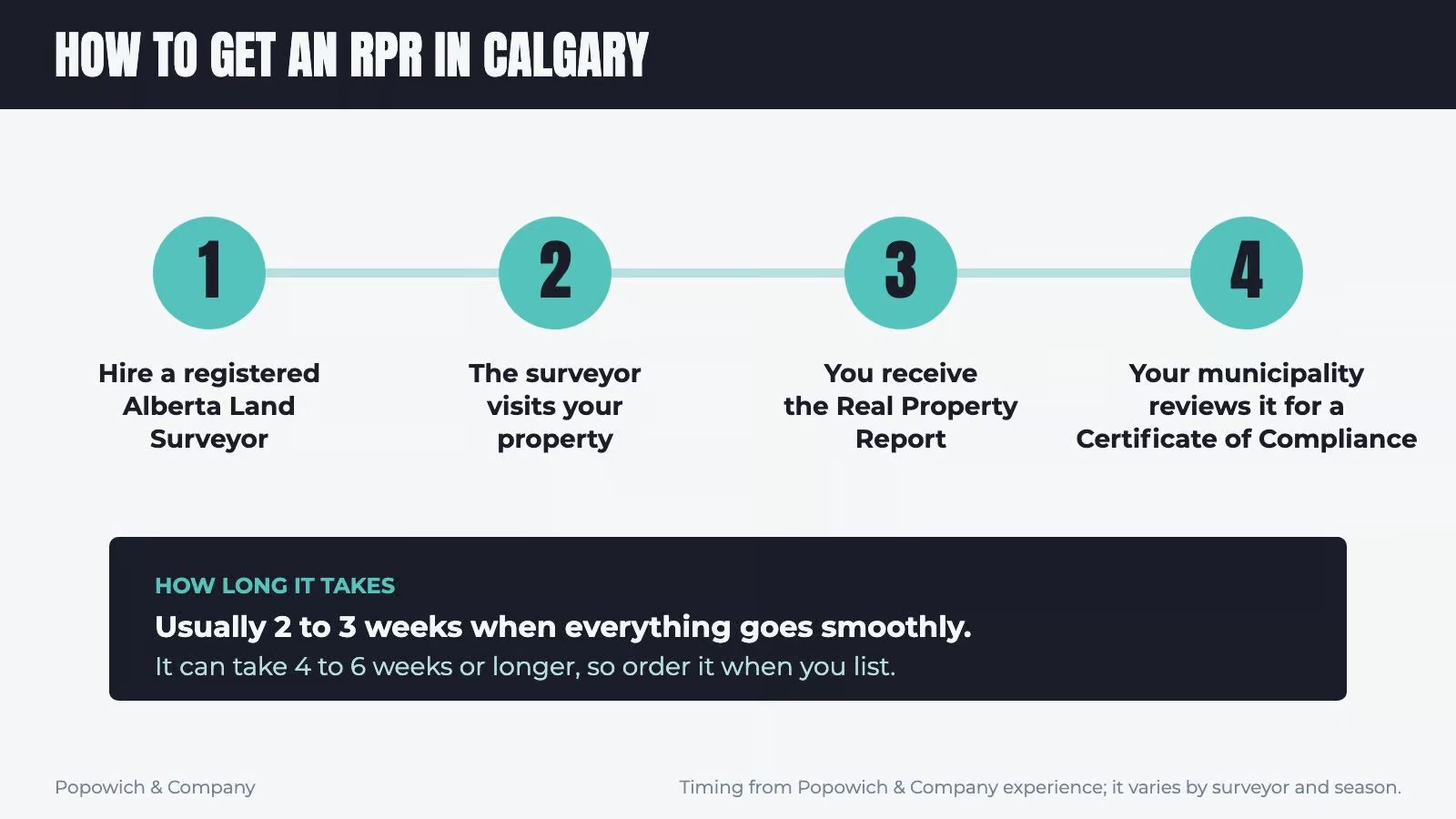
- Hire a registered Alberta Land Surveyor. The Alberta Land Surveyors’ Association maintains a public directory of surveyors who can offer services to the public you can use to find a company licensed to work in Calgary. We do not recommend specific surveying companies by name, but your REALTOR® can let you know what to ask about when you get quotes.
- The surveyor visits your property. A registered land surveyor attends the site to measure boundaries and record the location of all permanent structures.
- You receive the Real Property Report. The surveyor prepares the completed drawing, showing all structures relative to your lot lines, any encroachments and any registered easements.
- Your municipality reviews it for a Certificate of Compliance. The surveying company typically submits the RPR on your behalf; the municipality confirms whether the structures comply with its land-use bylaws and issues the compliance certificate. In Calgary, see the City of Calgary’s Certificate of Compliance page for the current fee and how to apply.
Usually 2 to 3 weeks when everything goes smoothly, but it can take 4 to 6 weeks or longer.
Get Clarity on What You Will Need Before You List
A Real Property Report is just one part of what it takes to get a Calgary home ready for market. For a full picture of the selling process in Calgary and what documents and timelines to plan around, our team is happy to walk you through it.
Thinking about selling and want to know what your home is worth first? Request a home valuation from Popowich & Company and our team will walk you through what it means for your plans.
Prefer to talk through the full picture? Book a consultation with Popowich & Company and our team will help you understand exactly what you need and when.

Get Our Newsletter
Sign-up to receive our latest listings, local real estate market insights, advice, and upcoming team events, right in your inbox.