





Picture it: a few acres west of Calgary, a home designed exactly the way you want it, and nobody over the back fence.
It’s a dream we hear about often, usually with one assumption attached: that building it from scratch will cost less than buying an acreage home that already exists.
The cost to build on an acreage in Alberta almost always comes out higher than buying resale, once you add the land, the construction and the site costs that never appear in a per-square-foot quote.
Key takeaways
- Building on an acreage in Alberta typically costs more than buying a comparable resale home, once land, construction and site services are added together.
- Site-dependent costs, including driveways, utility connections, well, septic and clearing, vary widely and are rarely included in the per-square-foot figure a builder quotes.
- A custom acreage build in Alberta realistically takes about four years on average from land purchase to occupancy, for someone very committed to the process.
- GST applies to new construction but generally not to resale acreage homes, adding cost to a build that buyers sometimes overlook.
- In Jonathan’s experience, acreage builds almost never come in at the original budget. Treat every estimate as a starting point.
Is it cheaper to build or buy an acreage in Alberta?
Buying a resale acreage is generally less expensive than building a comparable new home on bare land. The gap tends to be larger than buyers expect when they first run the numbers.
The reason is that acreage builds carry costs that do not exist in a resale purchase. You pay for the land, then for the construction of the house, and then separately for everything needed to make an undeveloped site livable: a driveway, utility connections, water, sewage, clearing, grading and potentially additional engineering. A resale home already has all of those things in place.
From my experience working with buyers and builders in this area:
I can say with confidence that, generally, under no circumstances would it be cheaper to build than purchasing an existing resale home.
Jonathan Popowich, Associate Broker & REALTOR®, Popowich & Company
There is a practical reason for that too. In Jonathan’s view, if spec building on acreages were profitable, you would see it. As he explains it:
There’s a reason why you don’t see very many builders, if any at all, that are constructing houses on spec to sell in acreage communities. And the reason why is because it’s so incredibly expensive to build an acreage for a very specific niche type audience with zero profit margin. In fact, it generally goes the other way, where if a builder does attempt to do this, they would end up taking a loss.
Jonathan Popowich, Associate Broker & REALTOR®, Popowich & Company
Thinking about buying or selling an acreage in Rocky View County or the Calgary area? Request a home valuation and our team will walk you through what your property is worth in today’s market.
What does building on an acreage in Alberta actually cost?
There is no single reliable answer, because acreage builds are almost entirely site-dependent. What you hear most often is a construction cost per square foot, which covers the house itself.
For high-end custom acreage homes in areas such as Central East Springbank, in consultation with the original builder of one such home, the builder suggested that building that same house today would cost approximately $600 to $700 per developed square foot (about $650 in the middle). “Developed” square footage includes a finished basement and unfinished spaces such as the garage and mechanical rooms, not just the above-grade living area. This figure is consistent with what Jonathan has seen from many prominent custom builders in the area (Jonathan Popowich, November 2026). That figure is for the house itself. It does not include the land or the site services described below.
What about specific house sizes?
Construction costs for a custom home in Alberta vary significantly depending on finish level, site conditions and location. A 1,500 sq ft home and a 2,000 sq ft home sit at very different points on the range depending on how the home is designed and finished. For a meaningful number, get quotes from several builders before you budget. Add the land, site services and the acreage-specific costs below, and the total will rise well above any per-square-foot estimate you are shown upfront.
What is the cheapest way to build a house on an acreage in Alberta? Choose a site close to existing utility connections, with minimal tree clearing and level terrain, and use an existing home plan rather than a fully custom design. Every variable that reduces distance, site complexity and design time reduces cost. Even so, buying a resale acreage with services already in place will typically cost less overall.
The hidden costs that builders do not quote up front
This is the part that catches buyers off guard. The per-square-foot construction cost is the house. Getting the site ready to build on is a separate category of expense, and every item on the list below is site-dependent, meaning the actual cost depends on your specific property.
Driveway and road access. The shape of the acreage determines how far from the property line the home site will be, which determines the length of driveway needed and whether it is built from pit-run gravel or pavement and concrete. Longer driveways cost more, and so does a higher-specification surface. Jonathan’s experience on a typical Springbank acreage puts a gravel driveway at approximately $30,000 to strip the topsoil to clay, lay pit run and base material, and finish with road crush ready for later paving (Jonathan Popowich, November 2026). That figure assumes typical soil and access conditions; actual costs depend on the site.
Utility connections. Power, natural gas, water lines and fibre all run in from the property boundary. The further the distance, the higher the cost. A 400-amp electrical service requires a significantly heavier cable than a 100-amp service, and both run on the same distance-dependent pricing. Trenching for multiple utilities adds up fast. For a conservative ballpark on a typical Springbank acreage, Jonathan estimates approximately $60,000 for utility services covering power, gas, phone, cable if applicable, and a water line if the property is on a co-op or private utility (Jonathan Popowich, November 2026). This figure depends heavily on service size, trench distance and whether one trench can carry all services, so it needs a site-specific quote.
Water. If the property does not have a water source, drilling a well is required. Jonathan’s experience puts the cost at approximately $20,000 for drilling and a basic flow test, plus approximately $10,000 to trench and connect the water line to the house with a pump (Jonathan Popowich, November 2026). These figures assume typical well depths and soil conditions for the area. Consult a licensed driller for a site-specific estimate.
Septic system. The design and installation cost depends on the soil, the lot’s tree cover, the topography and local regulations. A heavily treed or sloped lot can require a more complex (and more expensive) system. Jonathan’s experience puts the range at approximately $45,000 at the low end, $60,000 as a realistic middle, and $80,000 at the high end (Jonathan Popowich, November 2026). The system must be designed for the specific house and site, including a percolation test and assessment of topography. Consult an accredited designer.
Tree clearing. Clearing a forested area means paying for the work itself and for chipping or hauling the wood. It can also affect the type of septic system that works on the site.
Grading and site prep. Most municipalities have strict rules on maximum slopes and setbacks from environmentally sensitive areas. Steep or complex terrain can require retaining walls, additional engineering and geotechnical work.
Permits. Rocky View County governs what may happen on each site through a land use bylaw, which covers building position, setbacks from adjacent properties, drainage, topography and related matters. When a landowner wants to do something outside the bylaw, such as a grade relaxation, an overheight development, or a detached structure like a carriage house with a larger footprint than the bylaw allows, a development permit is required. When a development permit is needed, that process can take approximately three months (Jonathan Popowich, November 2026). Rocky View County’s current permit fee schedule is available in the County’s Master Rates Bylaw at rockyview.ca (last updated May 2025).
Design and architectural fees. A custom home requires architectural drawings before permits can be pulled.
GST. New construction is subject to 5% GST. A resale acreage home is generally GST-exempt (there are exceptions; consult a tax professional). For owner-built homes, a GST/HST new housing rebate may apply, but only when the home’s fair market value at substantial completion is under $450,000 (CRA, canada.ca, page last modified 2026-09-24). Most custom acreage homes in this price range will not qualify. Talk to an accountant before you budget.
Landscaping. Final landscaping almost always happens after occupancy and is a separate cost from the build.
Carrying costs during construction. A build takes time. That time costs money, in rent, storage, interim accommodation or interest on a construction loan running for a year or more before you can move in.
Caution
In Jonathan’s experience, acreage builds almost never come in at the original budget: “I have never, ever seen an acreage build come in under budget projections.” Build your contingency before you commit, not after the first surprise arrives.
A real example: what building the equivalent of 11 McKendrick Point would cost today
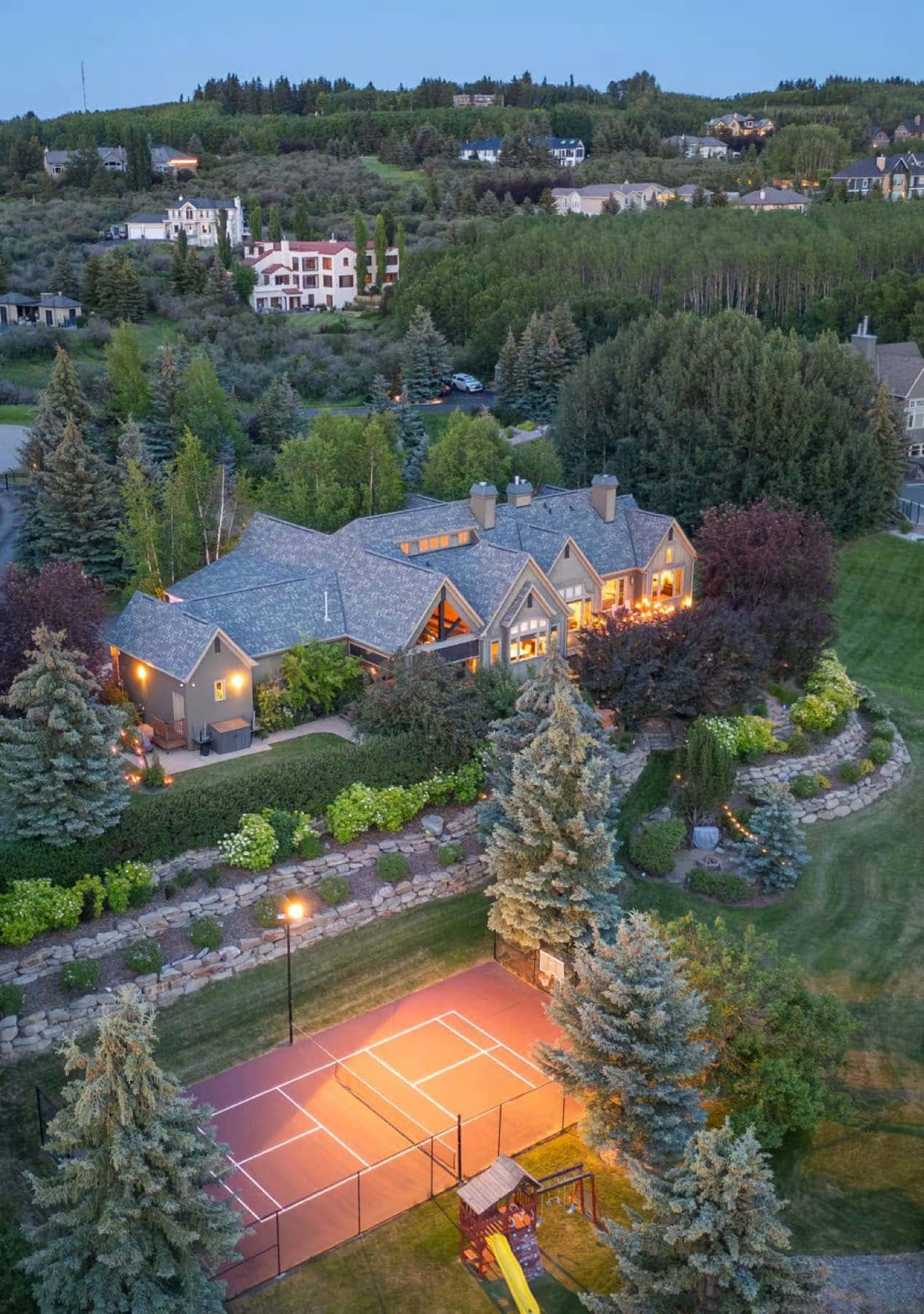
Our acreage listing in Rocky View County at 11 McKendrick Point is a 2015 custom-built home of 4,589 sq ft above grade (7,425 sq ft total living space) on 2.20 treed acres backing onto a ravine. The property has six bedrooms, four and a half bathrooms, an oversized quad heated garage, a swim spa, a BBQ kitchen, expansive decks, irrigation, a Control4 automation system and an air conditioning system. It is listed at $3,499,999 (MLS® A2352880) by Jonathan Popowich and Shaelyn Woods, REALTOR®, Popowich & Company.
What would it cost to build a comparable home on a comparable site today?
Jonathan walked through the numbers in November 2026:
Land: A bare two-acre site in Central East Springbank today would likely be in the range of $1 million to $1.1 million for the land alone.
Construction: In consultation with the original builder of this home, the builder suggested that building this same house today would cost approximately $600 to $700 per developed square foot (about $650 in the middle). Developed square footage includes the finished basement plus unfinished spaces such as the garage and mechanical rooms. At that rate, the construction cost falls somewhere in the range of $4,450,000 to $5,200,000. This figure is consistent with what Jonathan has seen from many prominent custom builders in the area (Jonathan Popowich, November 2026). The figure is for this house; it should not be treated as the going rate for every high-end Springbank home.
Jonathan’s summary: “Plus the $1 million lot, you would be safe to say that you would be encroaching on approximately five to six million dollars today to build this property.”
That figure covers land and construction. Site services, the gravel driveway, utilities, well and septic come on top of these figures, as does the landscaping, automation, outbuildings and outdoor features that are already in place on this property. Add those, and the gap between the cost to build and the asking price widens further.
These are estimates based on Jonathan’s professional experience as of November 2026 and should be treated as a planning benchmark rather than a guarantee.
| 11 McKendrick Point (asking) | Build equivalent today (estimate) | |
|---|---|---|
| Land (2 acres, Central East Springbank) | Included | ~$1,000,000 to $1,100,000 |
| Construction (~$650/sq ft across 7,425 sq ft developed) | Included | ~$4,450,000 to $5,200,000 |
| Site services, landscaping, outdoor improvements | Included | Additional (site-dependent, no estimate) |
| Total | $3,499,999 | ~$5M to $6M+ (land and build only) |
Source: Land and construction estimates, Jonathan Popowich, Popowich & Company, November 2026. Asking price: live Popowich & Company listing, MLS® A2352880, read 2026-11-07; listing facts confirmed by Jonathan Popowich against Pillar 9, 2026-11-10.
How long does an acreage build in Alberta actually take?
Building a custom acreage home is a multi-year commitment. Based on Jonathan’s experience going through this process multiple times and seeing dozens of clients navigate it, the average is about four years from buying the land to moving in, for someone who is very committed to the process (Jonathan Popowich, November 2026).
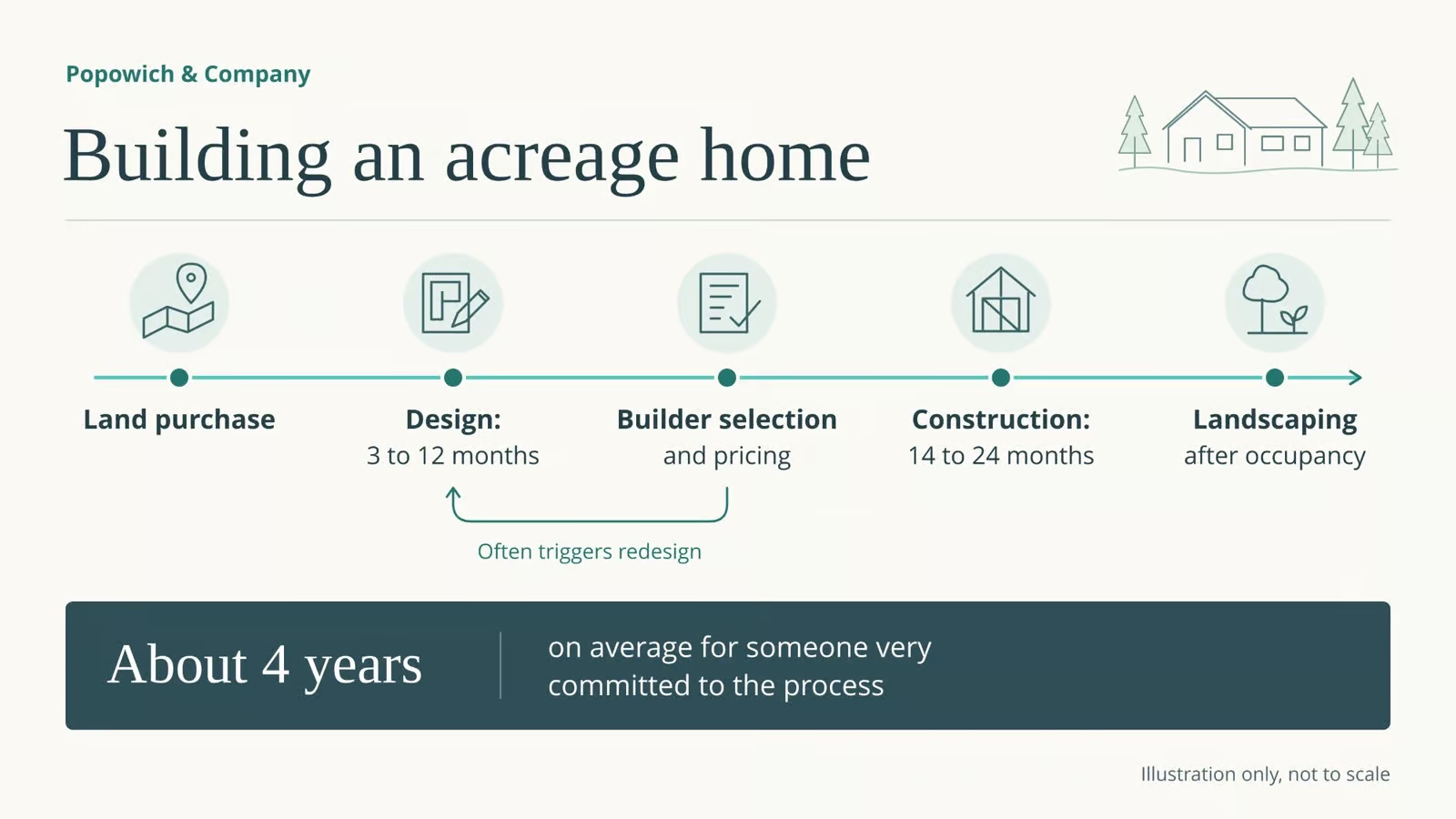
Design: The design process can take anywhere between three and twelve months. Even buyers with a clear vision or an existing plan to modify typically spend several months refining it.
Builder selection and pricing: After the design is confirmed, buyers usually enter a builder interview stage to select a builder and obtain preliminary pricing. That pricing often triggers some redesign to bring the project back into a workable budget, adding time before construction can start.
Permits: Rocky View County governs construction through its land use bylaw. Anything outside the bylaw, such as grade relaxations, an overheight structure or a detached building larger than the bylaw allows, needs a development permit. When a development permit is required, that process can take approximately three months before the permit is released (Jonathan Popowich, November 2026).
Construction: From breaking ground to occupancy, an optimistic timeline for a custom acreage build is approximately fourteen months. Twenty-four months is common. This does not include final landscaping, paving or the smaller items completed after occupancy.
Add the design phase and land acquisition, and four years is a realistic average for someone who is very committed to the process. During that time, you are paying for somewhere to live as well as for the build. That carrying cost is real and is part of the total cost of building.
How to decide: questions to ask before you choose
Before deciding to build, be honest about these:
Budget, in full. Most people planning a build see the land price and have an unrealistic expectation of what the house itself will cost. As Jonathan put it in November 2026, “Being crystal clear on their budget is without a doubt the most important thing that needs to be considered.” That means land, construction, every site service, carrying costs, a contingency and GST.
Timeline. Can your family’s needs in three or four years be served by a home you are designing today? Jonathan has seen buyers get well into the design process and realize their needs have changed. Empty lots sometimes change hands more than once before a home is built, as family circumstances shift.
Capacity to manage a build. A custom acreage build is a project you manage, not one that runs itself. Time, decisions and presence are required throughout.
Before evaluating a resale acreage, ask:
What services are already in place? A home with a well, septic, buried power and gas already connected is worth more than the sticker price implies. Replacing or upgrading any of those after purchase costs money.
Age and condition of the well and septic. These are acreage-specific costs that buyers from the city often do not know to ask about. Have both inspected as part of your conditions.
Permitting history. Were any outbuildings or improvements permitted? This matters for a Real Property Report and for future compliance when you sell.
If you are weighing acreage options in Rocky View County or the Calgary area, talking to a REALTOR® who understands both sides of this decision can help you avoid costly surprises. Browse our current acreage listings near Calgary, or if you own an acreage and are thinking about your next move, request a home valuation and our team will walk you through what your property is worth today.

Get Our Newsletter
Sign-up to receive our latest listings, local real estate market insights, advice, and upcoming team events, right in your inbox.